About Rethinking Africa
Watch. Think. Contribute.
An African-centred research, media and public-education platform
Rethinking Africa with Dr. Damola explores the ideas, systems and choices shaping Africa's development. Through research-based commentary, documentary storytelling, interviews, public conversations and creative media, the platform examines how Africans understand themselves, educate their children, organise their institutions, preserve their knowledge and imagine their future.
Africa is not empty of intelligence. Its challenge is that much of its intelligence has not been sufficiently recognised, refined, institutionalised, financed and transformed into collective power.
The platform therefore moves beyond simply describing Africa's problems. It asks how those problems were produced, what sustains them, what knowledge has been neglected and what practical alternatives can be built.
The full programme concept note is available for download: Programme Concept Note (PDF).
Challenging an intellectual imbalance
Africa is frequently presented through the language of crisis, poverty, corruption, dependency and failure. Although these challenges are real, they do not tell the complete African story. Across the continent, valuable knowledge remains hidden in communities, occupations, languages, cultural practices, indigenous institutions and the lived experiences of ordinary people.
At the same time, education and development systems may train Africans to admire what comes from elsewhere while distrusting what emerges from their own environments. Rethinking Africa was created to challenge that intellectual imbalance.
The purpose is not to romanticise the African past or reject knowledge from other parts of the world. It is to strengthen Africa's capacity to engage the world confidently, draw intelligently from global knowledge and participate without surrendering its voice, memory or agency.
Serious research made public
Rethinking Africa transforms serious research and lived African experience into accessible public knowledge: research-based video essays, interviews with scholars, practitioners and community knowledge holders, documentaries and field stories, short explainer videos, articles and policy insights, stories of African innovation and enterprise, and intergenerational conversations between elders and young people.
Every story begins with a question. Why does African education sometimes disconnect people from their environments? Why do major African projects continue to depend on imported expertise? Why do young people frequently reject the occupations and knowledge of previous generations? How can indigenous knowledge become modern science, industry and enterprise? How can Africa modernise without becoming a copy of another civilisation?
How we think
African-centred
Africa is treated as a legitimate centre of knowledge, interpretation and possibility.
Evidence-based
Arguments are supported by research, data, history, professional experience and community testimony.
Critical
The platform confronts colonial legacies, global inequalities and internal African failures without sentimentality.
Constructive
Criticism must lead towards alternatives, innovation and action.
Accessible
Complex academic ideas are translated into language everyone can understand.
Future-oriented
Not only what happened to Africa, but what Africa can now recover, rebuild and create.
Read our editorial and research standards.
Meet Dr Damola
Dr Oluwakemi Damola Adejumo-Ayibiowu, PhD
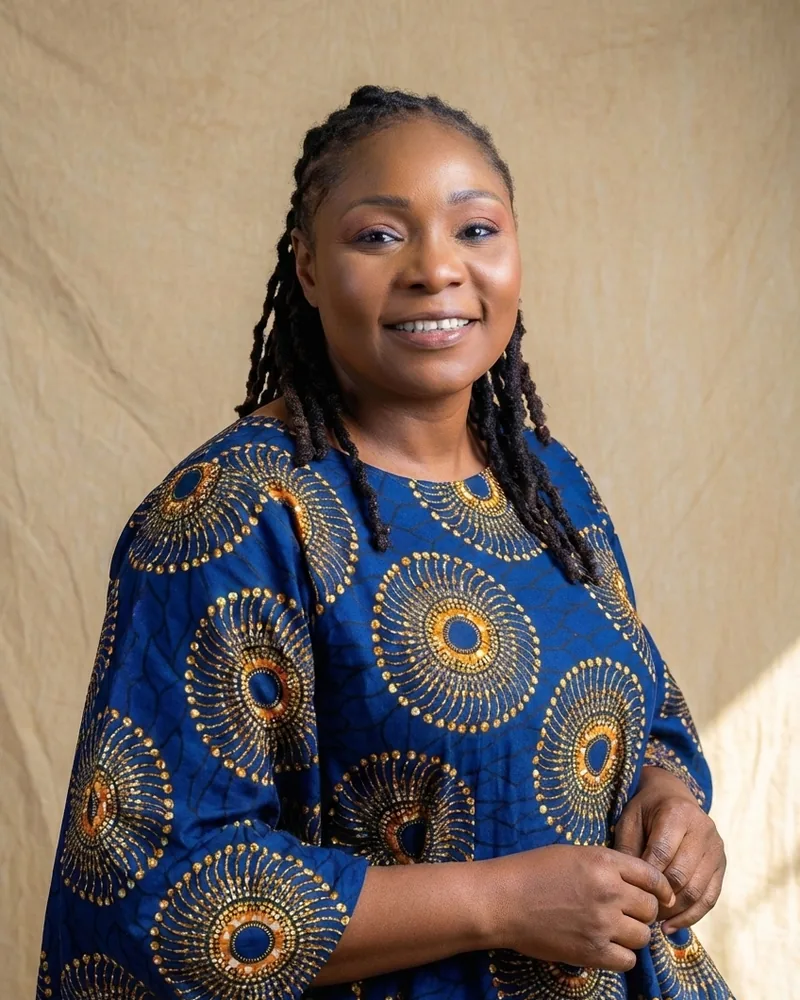
Dr Damola is a development economist, Afrocentric scholar, AI generalist, public policy strategist and gospel music artist with over 25 years of experience spanning government, academia and international consultancy. Her work is driven by purpose, truth and transformation, and it sits at the intersection of policy reform, decolonised knowledge systems, artificial intelligence and creative expression.
As a scholar, her research explores Afrocentric governance, African renaissance and the decolonisation of knowledge. She is a Senior Postdoctoral Fellow at the University of South Africa (UNISA), deepening her work on indigenous knowledge systems, policy innovation and how emerging technologies like AI can reshape Africa's development trajectory when grounded in local realities, asking not just what technology can do, but who it serves and how it aligns with Africa's renaissance agenda.
Her professional journey includes roles in national institutions such as the Central Bank of Nigeria and the Nigerian Revenue Service. Internationally, she has consulted for the World Bank, UNDP, the EU and IFAD on institutional reform, development evaluation and culturally grounded approaches to economic transformation.
She has published and presented across Africa, Europe and North America, and holds a PhD in Development Studies (UNISA), an MSc in Poverty Reduction and Development Management (University of Birmingham, UK) and a BSc in Economics (Obafemi Awolowo University, Nigeria). She is a Prosci® Certified Change Management Practitioner and a member of AIKRN, CITN, NIM, ANAN and NES.
Beyond academia and policy, she is a songwriter and founder of the Oratorio Music Foundation (est. 1996), through which she has mentored young people and led campus-based gospel music initiatives. As the daughter of the legendary Nigerian comedian Baba Sala, she carries forward a family legacy of creative impact through music and comedy released under the name Oyindamola.
Across all she does, Dr Damola seeks to advance Africa-centred scholarship and AI applications that challenge dominant paradigms; reform public sector systems for equity, accountability and national growth; nurture Afrocentric leadership that fuses wisdom, technology and cultural values; and use music and mentorship to draw hearts back to God and inspire transformation.
ORCID iD: 0000-0001-5086-7364 · View all publications
Not a platform where one person speaks
Rethinking Africa is a growing community of scholars, students, professionals, artists, entrepreneurs, policymakers, artisans, elders, young people and members of the African diaspora.
You are invited to propose a story or episode, participate in an interview, contribute a research reflection, recommend a scholar or practitioner, share a community innovation, identify neglected African knowledge, suggest solutions to development challenges, or partner on research, media and public-engagement projects.
Africa must not only be studied. Africa must speak, think, create and determine.